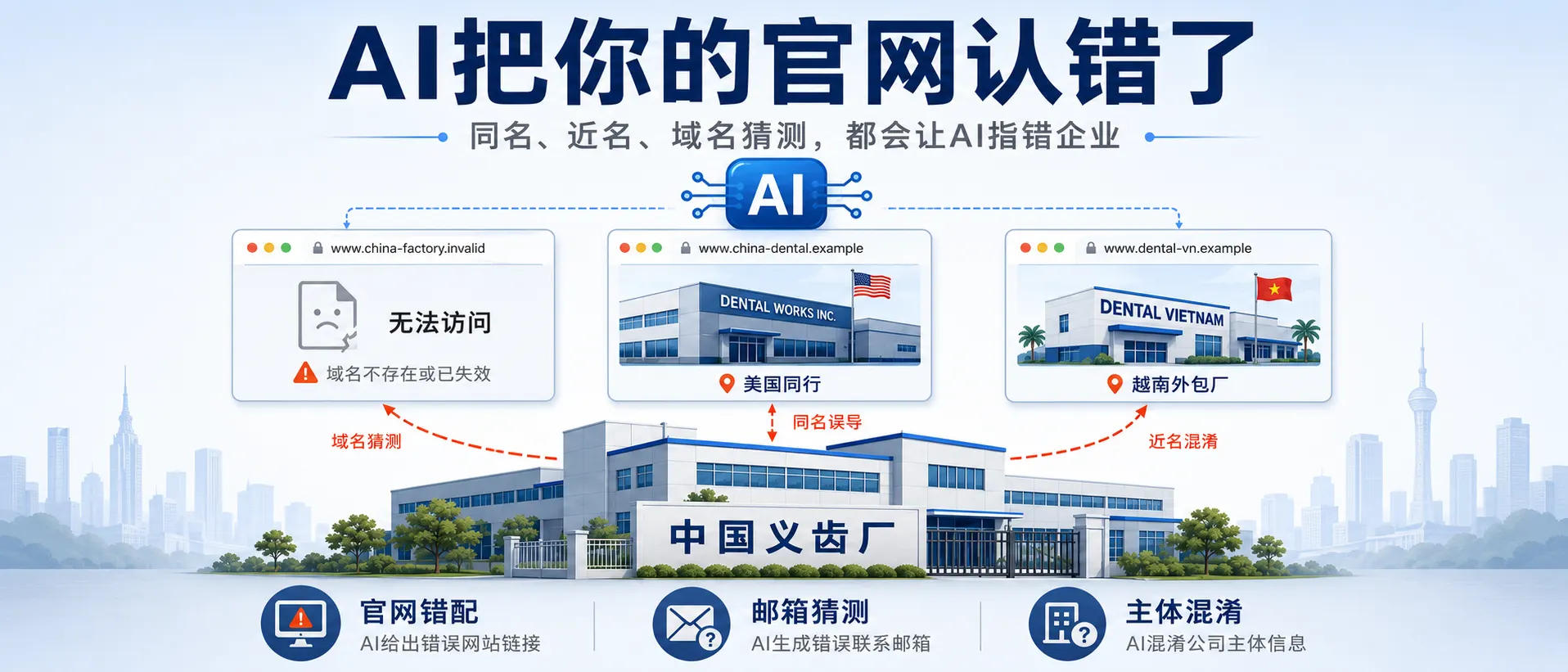
On the afternoon of July 22, I asked one mainstream AI model to find the English websites and contact emails for three Chinese dental labs.
All three website answers were wrong. One pointed to a domain that did not work during the test, one to a laboratory in Kentucky, and one to an outsourcing company in Ho Chi Minh City.
If an overseas buyer uses AI to verify the same factories, the buyer may receive the same kind of confident but incorrect answer.
These were not obscure workshops
The businesses already had recognizable Chinese and export-facing web footprints. Promax's site identifies a Zhuhai facility and says it has more than 300 technicians. Advanced Dental Laboratory identifies itself as a Shenzhen laboratory with more than 12 years in prosthetics. The World Medical site contains a substantial dental-product catalogue and Fuzhou-related company sections.
This test examined identity and contact matching. It did not revalidate current FDA, ISO or CE status. Any regulatory record must be checked against the exact entity, address, scope and date.
The AI response looked complete: three websites, six email addresses and polished company descriptions. Opening the links told a different story.
Case 1: a guessed domain and email
The AI gave the Zhuhai lab promaxdental.com. During the July 22 test it did not open. On July 28 it redirected to a UK dental site—still not the Zhuhai laboratory.
The China-based page identifies Promax Dental Laboratory in Zhuhai at promaxdl.com. Its public email is info@promaxlab.com.
The brand says Promax, the website says Promax DL and the email says Promax Lab. A person can infer the relationship. AI may split them—or invent info@promaxdental.com from a familiar pattern.
Case 2: a Shenzhen exporter became a Kentucky lab
The AI supplied adldental.com. That site says its work is performed in Kentucky and gives a Louisville address.
The China-based business is presented at adldentalab.com, which identifies Advanced Dental Laboratory as a full-service lab in Shenzhen and publishes a Shenzhen factory address and info@adldentalab.com.
A few letters separated a Shenzhen export laboratory from an unrelated US namesake. Following the wrong link changes the identity, location and contact path before the buyer reaches the Chinese factory.
Case 3: a Fuzhou business became a Vietnam company
The AI returned worlddentallab.com. Its contact page identifies World Dental Lab as a trading name of HDental Co., Ltd., lists Ho Chi Minh City addresses and uses a +84 number.
The China-related site is wdentallab.com, whose pages identify World Medical Technology Co., Ltd. and contain Fuzhou-related sections. Its English information is less complete and the brand name is highly generic.
Among several businesses called “World Dental Lab,” the company with richer English pages can become AI's default answer—even when it is in the wrong country.
The model acknowledged inferring the answers
When asked where the URLs came from, the model said it had not actually visited the sites and had inferred them from brand names and common domain formats.
In plain language: the websites and emails were guessed, while polished claims such as “long-standing North American clients” were not supported by the cited pages.
The dangerous failure is not silence. It is a fluent answer that turns inference into apparent fact.
Evidence boundary: this records one model's first answer and follow-up explanation on July 22. It is not a stable ranking, a supplier-quality judgment or proof that every AI product will return the same errors.
The errors extend beyond websites
A July 21 test also found AI assigning qualification language to the wrong entity level. Read the certificate-attribution case.
Four errors now recur: wrong website, wrong legal entity, wrong address and unclear qualification ownership. These are among the first identity checks an overseas buyer performs.
What this can mean for an order
A buyer who reaches a US namesake may not email the Chinese lab to ask which website is correct. The buyer may simply move to the next supplier.
There is no evidence that one AI identity error automatically causes a lost order. But it raises verification cost and increases the chance that the buyer skips the company before requesting a quotation.
Why AI can misidentify your factory
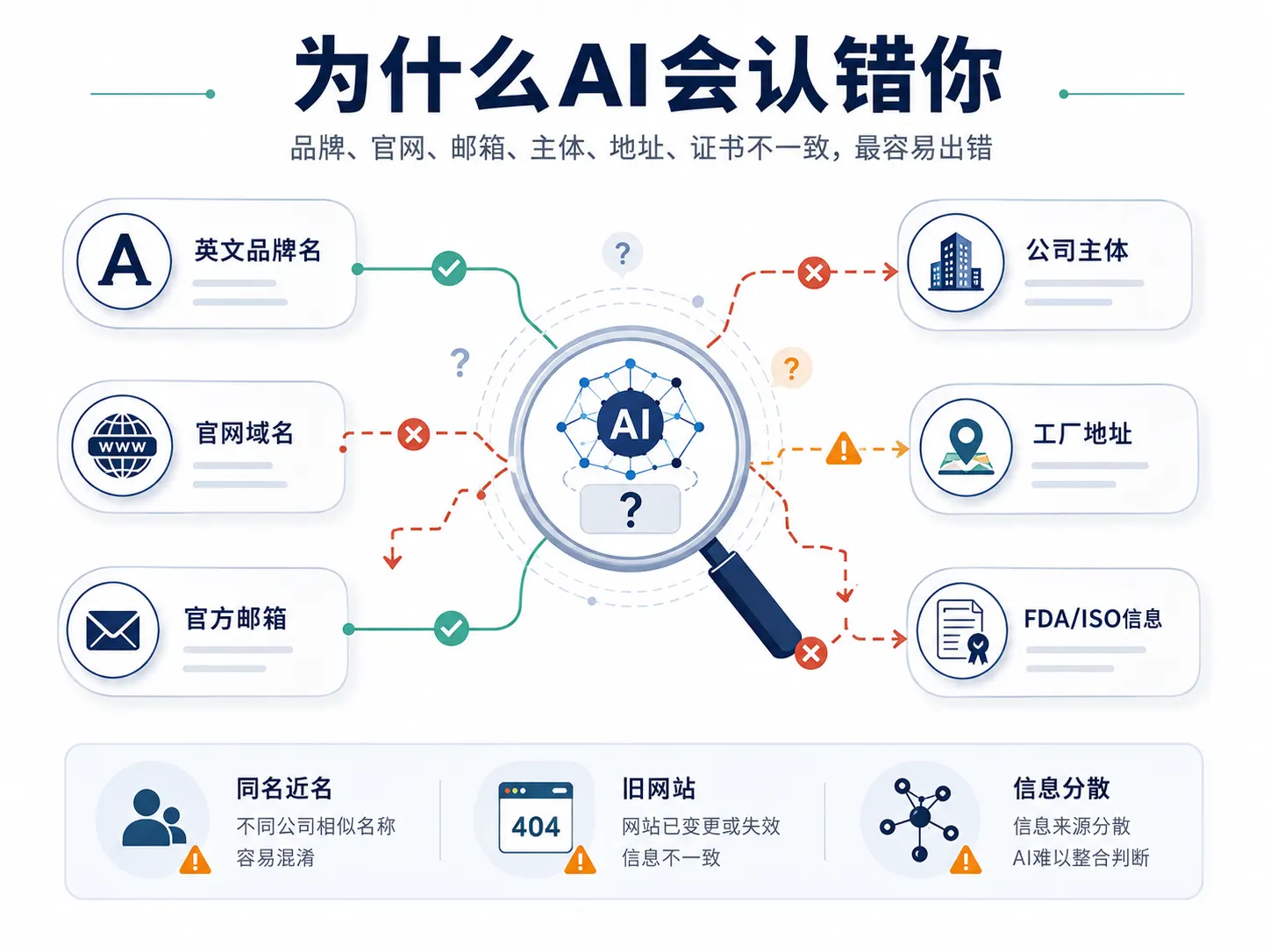
- The name is generic. ADL, Promax and World Dental Lab have namesakes in several markets.
- The brand, website and email use different variants. Their relationship is not explicit online.
- The homepage does not identify the entity. Product pages without a company name and factory address leave AI to infer ownership.
- Qualification claims lack scope. Registration, certification, group, factory and material claims appear interchangeable.
How to reduce misidentification without a large budget
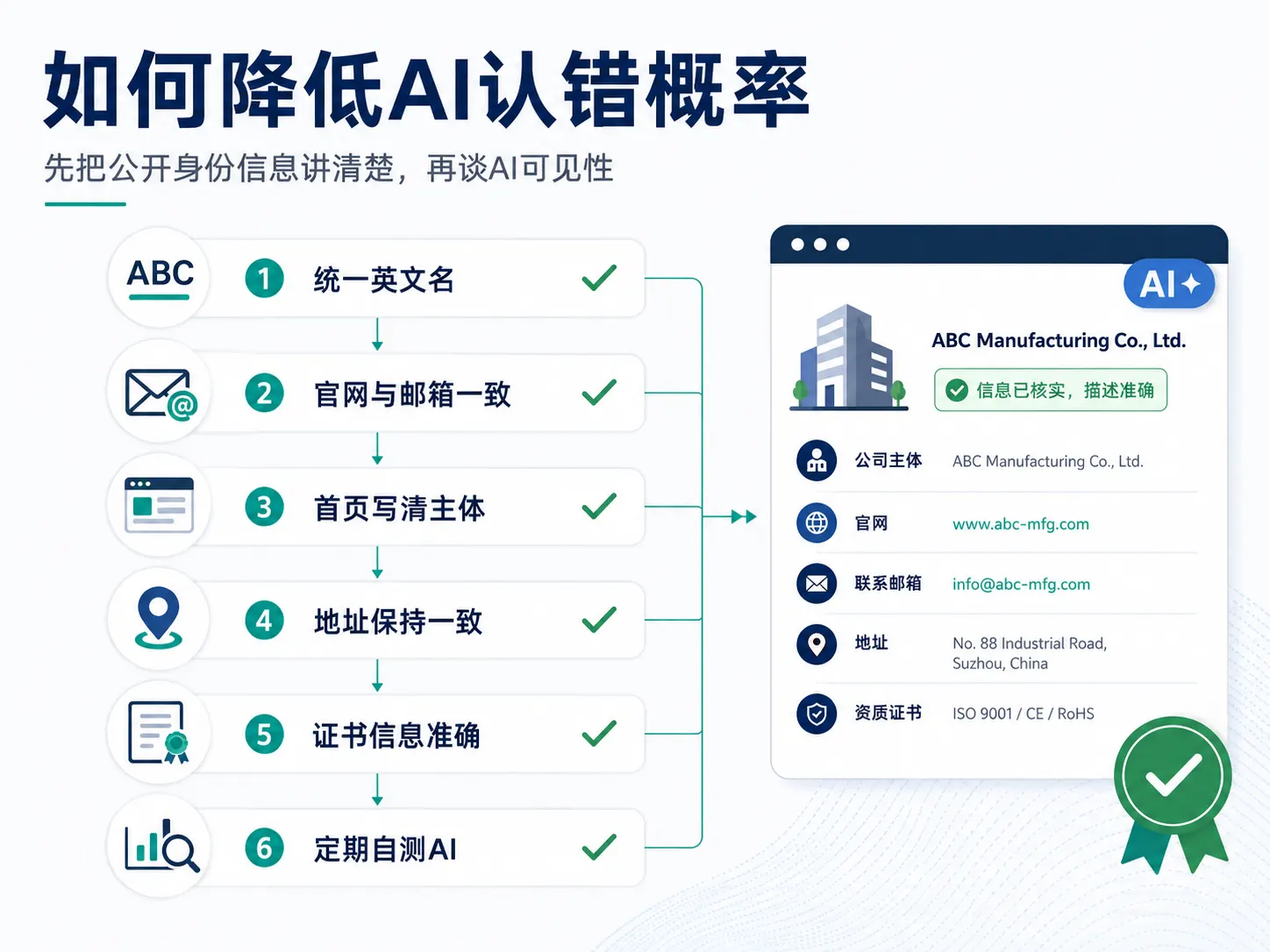
- Use one English identity set. Keep the brand, legal name, factory address, website and email consistent across public materials.
- State who you are on the homepage. Publish the company name, Chinese factory address, founding year, official email and brand-entity relationship.
- Run a monthly identity check. Search the brand and ask selected AI systems whether they found the correct company, website and source. Save screenshots.
First help AI identify who you are
The entry-level AI visibility snapshot records whether selected AI systems find the lab, identify the correct website and entity, cite the right sources, and repeat unsupported claims.
It does not promise rankings, fabricate recommendations or replace regulatory and commercial due diligence.